Sunscreen,
explained in full.
Count the days you wore sunscreen this week. If the answer is zero, you're not behind — you're the majority.
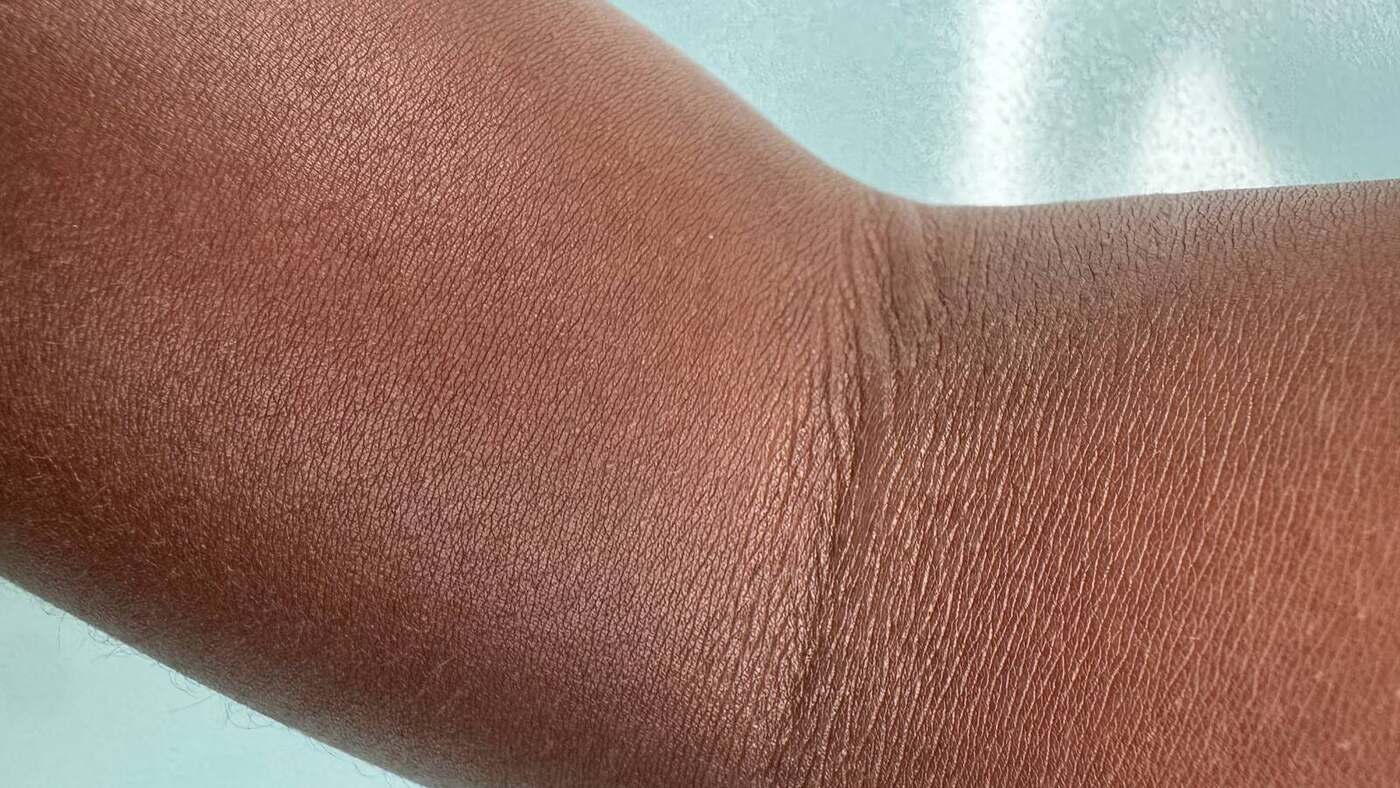
And it's the belief that costs the most: that melanin-rich skin doesn't need it.
Not because the sun burns — on a type V or VI, you may never turn red. But because every exposure feeds the very marks you're trying to fade.
If you use retinol, niacinamide or vitamin C without sunscreen in the morning, you're paying for work the sun undoes by lunchtime.
What it actually is
Sunscreen filters radiation before it reaches your skin. Two families: mineral filters (zinc oxide, titanium dioxide), which reflect, and chemical filters, which absorb.
Two things to read on the box, and they don't mean the same thing. The SPF number measures protection against UVB — the burning rays. "Broad spectrum" means it also covers UVA — the ones that go deeper and pass through glass.
An SPF 50 that isn't broad spectrum protects you from half the problem.
Why this matters more here
Melanin protects — partly
Five times less UV reaches the deep dermis of dark skin than of fair skin (Kaidbey, 1979, comparing black and Caucasian skin). That's real, and it's nowhere near enough. It filters mostly UVB and leaves you exposed to deep UVA. Researchers are still debating how much credit melanin deserves — Brenner and Hearing call its photoprotective role "still controversial."
And then there's visible light
Visible light — an overcast day, a window — triggers pigment on darker skin. Not on fair skin, where it mostly causes passing redness. On us, it makes pigment, and that pigment stays.
The catch: ordinary sunscreens, even broad spectrum, don't block it. The mineral filters used as nanoparticles — precisely the ones chosen to avoid a white cast — are transparent, so visible light goes straight through.
What blocks it is iron oxides (listed as iron oxides on the label). Which means: a tinted sunscreen. For a sunscreen to protect against visible light, it has to show on your skin.
What I see most often
It isn't someone without sunscreen. It's someone who owns one, wears it, and is protected at a quarter strength — because nobody ever told her how much to use.
What I'd do in your place: before changing product, change the amount. For two weeks, use twice what you thought was enough. If your tube still lasts three months, you aren't using enough.
The amount — the factor almost nobody mentions
You can buy the best sunscreen on the market and get a fraction of the protection printed on it. It isn't the product. It's the dose.
The number that changes everything
SPF is measured in a lab at 2 mg of product per cm² of skin. In real life, people apply between 0.39 and 1.0 mg/cm² — a fifth to a half of what was tested. And protection doesn't drop proportionally. It collapses.
Two rules that hold
- The two-finger rule — for face and neck: two lines of product, base to tip of your index and middle fingers. It looks like far too much the first time. It's the right amount.
- Reapply once within the hour after the first application. That's the fix the authors themselves propose: built to be followed rather than perfect, it recovers most of what was missing.
Your situation → what to do
Everyday
- Office day, few windows — broad spectrum SPF 30 in the morning. One application is enough.
- Beside a window all day — tinted SPF 30 to 50. UVA and visible light come through glass.
- Winter, overcast — yes, still. UVA goes through cloud.
When your skin marks
- You're working on dark spots — tinted SPF 50, iron oxides. Non-negotiable: without it, your brightening actives work at a loss.
- You've just started retinol — SPF 50 every morning, no exceptions. Skin is more reactive to sun.
- A day outdoors, sport, the beach — SPF 50, reapply every 2 hours, and after sweating or swimming.
- Oily or breakout-prone skin — look for "fluid," "gel," "non-comedogenic." Texture decides whether you'll actually wear it.
How to choose
The objection isn't theoretical: plenty of sunscreens leave a grey film on deeper skin. A product you don't want to wear is a product you don't wear.
01 · Tinted, with iron oxides. Look for iron oxides or CI 77491 / 77492 / 77499 in the list. It's the line that matters most when your skin marks.
02 · A fluid texture. Fluid, gel or lotion rather than a thick cream. This is what decides whether you wear it daily.
03 · A finish you like. Matte, satin or luminous. The best sunscreen is the one you put on.
If you're between two shades, take the darker one: too light shows, slightly too dark blends.
If it goes wrong
- It leaves a white cast — massage longer, in thin layers. Next time: a tinted or hybrid formula.
- It stings or burns — rinse, go back to your basic routine for 2 or 3 days. Next time: a tinted mineral sunscreen, often better tolerated, with a 48-hour patch test.
- You break out — stop that product, keep the basics for 7 days. Next time: "non-comedogenic," gel or fluid texture.
- It pills under makeup — wait two minutes between moisturizer and sunscreen. And avoid layering gel over silicone.
- It looks shiny by evening — blot with a tissue, don't rub. Next time: a matte finish, or a tinted powder over the top.
- You never remember — put the tube beside your toothbrush. Attach the habit to one that's already automatic.
What it doesn't replace
- A high SPF replaces neither shade, nor a hat, nor clothing.
- Too little product sharply reduces real protection.
- A mark that changes shape, grows, bleeds, or hasn't moved after several months: show it to a health professional. This page is not a substitute for a consultation.
And next
In the method
This is the Protect step of the Kwélia method. It doesn't come last by accident: without it, the other steps lose part of their effect. In the morning, sunscreen is the final step — after serum and moisturizer.
Read also
- Retinol and dark skin — the active that makes sunscreen non-negotiable
- Niacinamide — what works on marks while sunscreen keeps them from coming back
- Skin phototypes IV to VI — why this advice is different for us
The free guide, 7 pages
The three habits that keep dark marks going on melanin-rich skin, and what to do instead. Every claim carries its source.
Now, your routine.
Pick your starting point. You can begin without paying anything.