Niacinamide,
explained in full.
Take the most expensive serum in your bathroom and look for a percentage on the box. If there isn't one anywhere, you don't know what you paid for.
Niacinamide is the active where that number matters most — and the one where it's missing most often.
Niacinamide is a form of vitamin B3, water-soluble. On melanin-rich skin it's also one of the most useful — and for a specific reason.
Why this matters more here
Inflammation is where marks begin
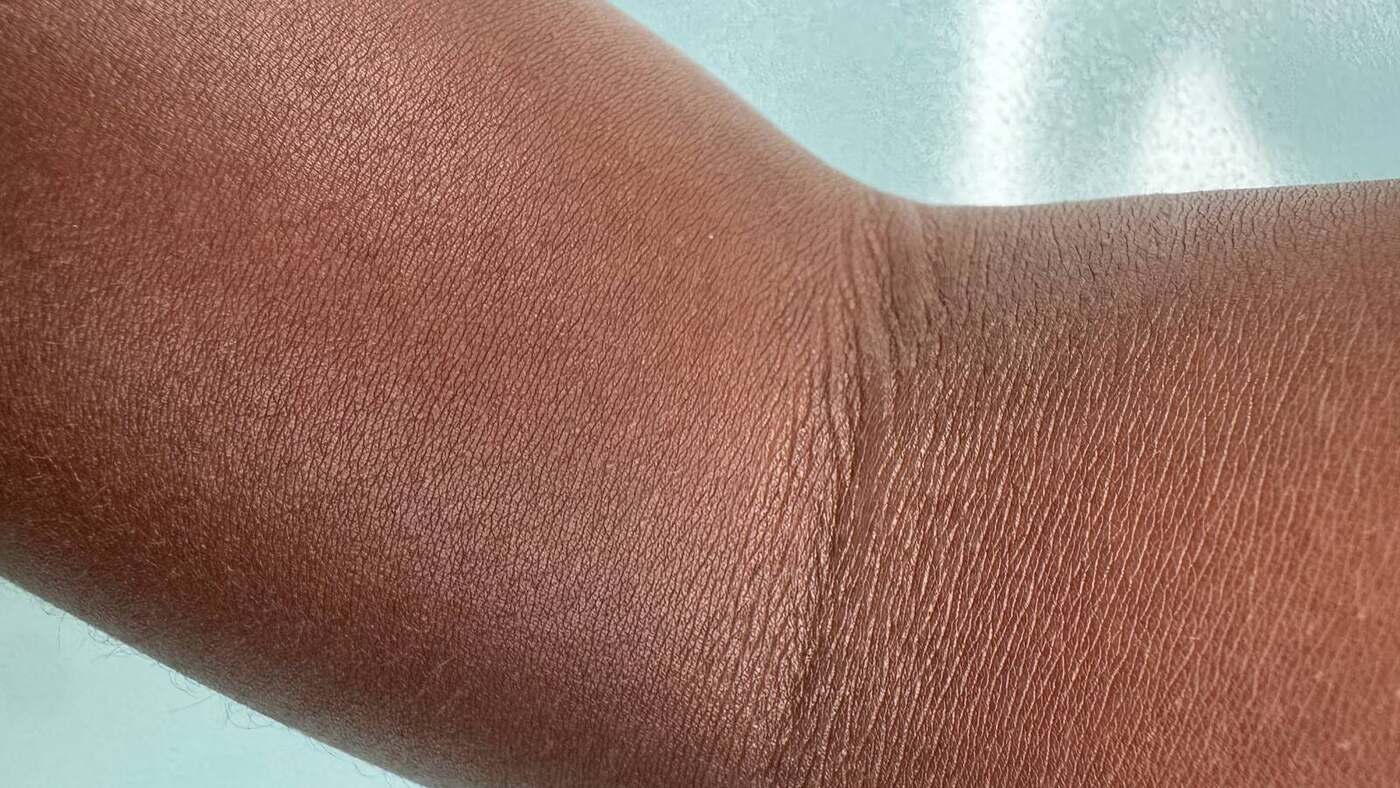
On our skin, the chain is nearly always the same: irritation → inflammation → mark. A breakout, friction, a reaction to a product, and what was only redness leaves something behind.
Niacinamide works on three links of that chain at once.
01 · It slows the pigment down. Pigment is made by melanocytes, then handed off to the surface cells. It's that hand-off niacinamide slows — marks reduced after 4 weeks in the reference trial.
02 · It strengthens the barrier. It stimulates ceramide production, the lipids that hold water in. In cell culture, ceramide synthesis rose 4.1 to 5.5-fold. On skin, the study showed more ceramides in the outer layer and less water loss — a real effect, measured differently.
03 · It regulates oil. And reduces the look of enlarged pores.
A strong barrier is skin that irritates less. Skin that irritates less is fewer marks. That's the whole logic.
Who it's for
It's for you if:
- Your skin is oily, or your T-zone shines
- Your pores look enlarged to you
- You have redness, or skin that reacts quickly
- Your tone is uneven, or you get marks after breakouts
- You want a straightforward first active, with no special precautions
What I see most often
Someone who bought a 20% serum thinking it was four times better than a 5%. It stings, the skin goes red — and on us, redness that lingers becomes a mark. The expensive bottle set the skin back.
What I'd do in your place: take a 5% and hold it for four weeks without changing anything else. That's the concentration in the trial, it's the one that was measured, and it's plenty.
Concentration — the only number that counts
Four reference points
- 2 to 4 % — very reactive skin, first try. Start here if you've never used an active.
- 5 % — the benchmark. This is the concentration from the pigmentation trial: effective and well tolerated.
- 5 to 10 % — the useful range for most skin.
- Above 10 % — almost nobody. Irritation risk climbs without a matching gain.
More is not better
On deeper skin, irritated skin marks more easily: a 20% serum that makes you red costs you more than it gives you.
And if the packaging gives no percentage at all, you cannot know what you're buying. Look for the number.
When to apply it
Morning or evening, your choice
It's gentle enough for both, and plenty of people use it twice a day. Morning: after cleansing, before moisturizer and sunscreen. Evening: after cleansing — it sits well on nights without retinol.
In the order of a routine, it comes after the most fluid textures and before the thickest — so after a watery serum, before cream.
What to pair it with
No difficulty
- Hyaluronic acid — no precautions, on slightly damp skin.
- Sunscreen — this is the basic morning pair.
- Ceramides — they do the same job by two different routes.
- Vitamin C — apply it first, wait about fifteen minutes. The old prohibition came from unstable formulas; current ones combine fine.
With care
- Retinol — one after the other, never mixed in your palm. Many prefer niacinamide in the morning, retinol at night.
- Exfoliating acids (AHA/BHA) — space them out: acid one night, niacinamide another.
If it goes wrong
Well tolerated doesn't mean tolerated by everyone
- It stings or turns red — rinse, go back to cleanser and moisturizer for two days. Then drop to 4 or 5%, every other day.
- Small bumps appear — stop for seven days. If they clear, the product is the cause, not necessarily the active: fragrance or another ingredient may be responsible.
- A flush of heat across the face — rare, and passing. Lower the concentration.
- You see nothing after 4 weeks — keep going. The reference trial measures the difference at 4 weeks, not before.
- You started everything at once — stop all but the basics for seven days, then reintroduce a single active. Introduce it alone, not alongside another new active. Otherwise, if something reacts, you won't know which of the two caused it — and you may drop the one that suited you.
How long before you see anything
Four weeks minimum
And that's the figure from the trial, not an estimate. For oil and pores, often sooner. Take a starting photo in daylight: day to day, you don't see your own skin change.
Care
What to know
- Niacinamide does not replace sunscreen. It slows pigment production; the sun starts it up again. Without protection, you're working at a loss.
- A reaction that lasts, a burn, a mark that changes shape or bleeds: show it to a health professional. This page is not a substitute for a consultation.
- Introduce it alone, not alongside another new active.
- Above 10%, irritation risk climbs without a matching gain.
- A doubt, a reaction: space it out, then restart lower.
And next
In the method
It straddles two steps of the Kwélia method: Repair, because it strengthens the barrier, and Activate, because it works on pigment. That's what makes it such a good first active — it works while you build the rest.
Read also
- Sunscreen and dark skin — without it, niacinamide works at a loss
- Retinol and dark skin — the evening active, to introduce slowly
- Skin phototypes IV to VI — why irritation leaves a mark on us
The free guide, 7 pages
The three habits that keep dark marks going on melanin-rich skin, and what to do instead. Every claim carries its source.
Now, your routine.
Pick your starting point. You can begin without paying anything.